AI to Expedite Sex/Gender-Based Analysis in Evidence Synthesis
Integrating sex and gender into evidence synthesis remains a major gap in health research, including complementary and integrative medicine. The project aims to accelerate the consideration of sex and gender in evidence synthesis by using artificial intelligence (AI). Strengthening sex and gender aspects in evidence synthesis projects, such as in systematic reviews and guidelines, will support more equitable, relevant, and patient-centred healthcare decisions.
Why sex and gender-based analysis matters in evidence synthesis
Evidence synthesis helps researchers and healthcare professionals make sense of large volumes of scientific information by systematically identifying, evaluating, and summarizing available studies. However, sex and gender are still often missing in this process, even though they can shape disease risks, treatment responses, and overall health outcomes.
Overlooking sex and gender aspects can maintain relevant differences hidden, potentially leading to biased conclusions and less effective or less equitable care. Integrating these aspects into evidence synthesis strengthens the research evidence used in health decision-making.
Using AI to improve sex/gender-based analysis: Opportunities and risks
Conducting evidence synthesis projects is time-consuming. AI has the potential to automate several steps, such as study selection and data extraction, reducing workload and speeding up the review process. AI tools may also help identify sex/gender-related information more efficiently. However, AI systems can unintentionally reinforce existing biases if they are not carefully evaluated and monitored.
This project addresses these potential opportunities and risks by studying how well different AI tools perform and by developing guidance to ensure they support rather than undermine equitable research practices.
Why it matters for Complementary and Integrative Medicine
Women use complementary and integrative therapies more frequently than men, yet sex- and gender-based differences in health and treatment response remain underexamined. Our evidence synthesis work helps address this gap.
Project aims
This project attempts to improve the consideration of sex/gender in evidence synthesis through AI-driven methods. Its goals and specific objectives are the following.
Goal 1: Collect information about the use of AI to expedite the consideration of sex and gender in evidence synthesis
- To map evidence syntheses on sex/gender specific health and describe the AI tools used in these reviews
- To assess how sex and gender, equity and intersectionality are considered in guidelines of digital health interventions for cancer
- To map methodologies for AI prompt development and evaluation in health
- To describe the information presented on the websites of digital evidence synthesis tools about the performance of their AI functionalities
- To explore the opportunities and challenges for the use of AI to consider sex and gender in evidence synthesis
Goal 2: Evaluate the performance of AI to consider sex and gender in evidence synthesis
- To evaluate the performance of AI tools to identify and select studies assessing the role of sex and gender as a prognostic factor
- To evaluate the performance of Large Language Models to assess the consideration of sex and gender in randomized clinical trials and systematic reviews of digital health interventions for cancer
Goal 3: Develop AI tools to expedite the consideration of sex and gender in evidence synthesis
- To create a bank of prompts to consider sex and gender in evidence synthesis
- To propose an AI Framework to expedite the consideration of sex and gender in evidence synthesis
Methodological approach
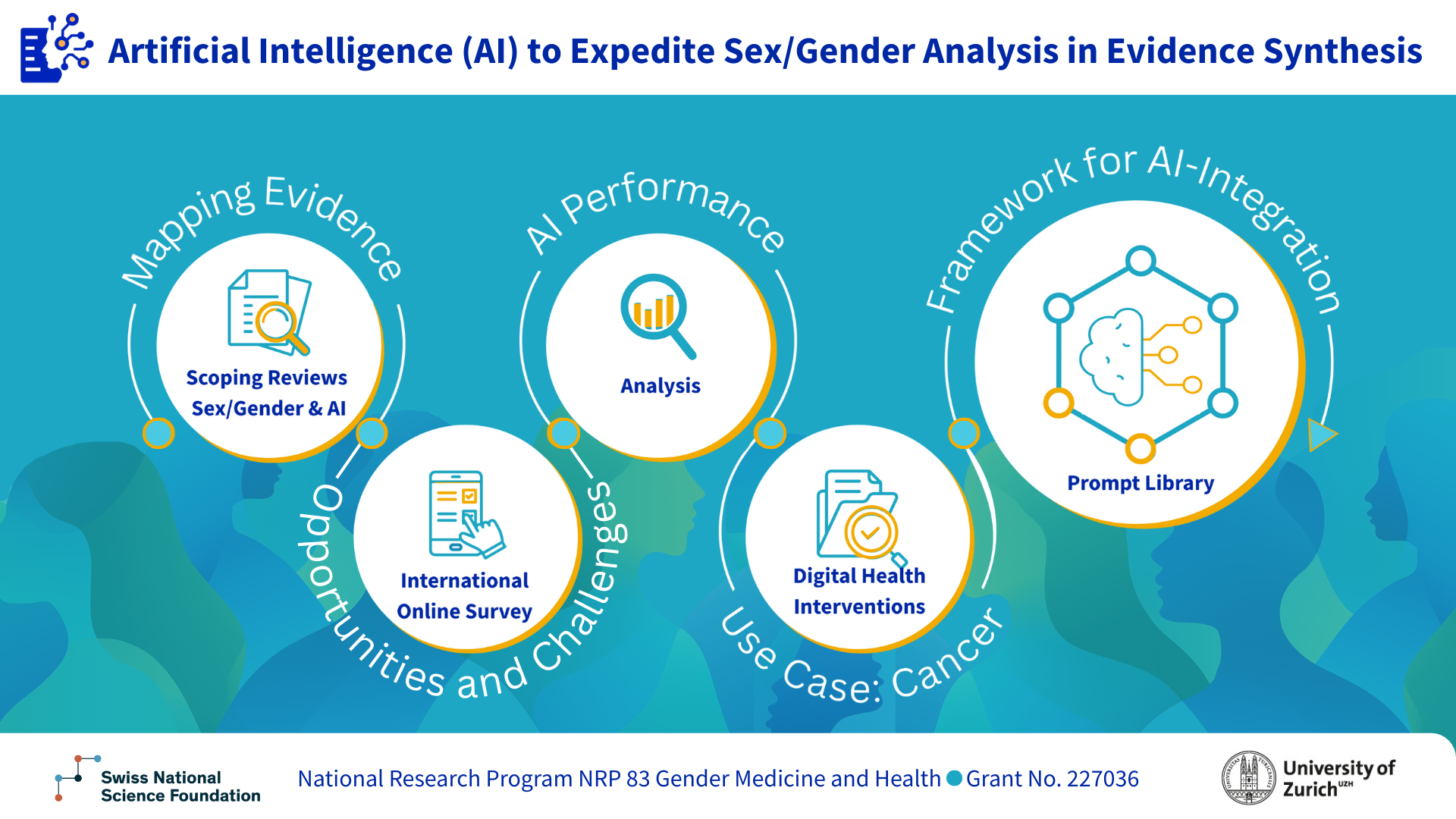
This three-year mixed-methods project (2025–2027) combines scoping reviews, cross-sectional studies, surveys, AI performance studies, and consensus processes. Engagement with diverse interestholders including healthcare professionals, patients, evidence synthesis professionals, guideline developers, methodologists, and AI experts is integrated from the beginning of the project to ensure that tools and findings are practical, inclusive, and relevant to real-world needs.
Funding
This project is funded by the the Swiss National Science Foundation within the National Research Programme NFP 83, Grant 227036.
Project leaders
- Claudia M Witt
- Jesús López-Alcalde
- Janna Hastings, Idiap Research Institute Switzerland
Project team
Project partners
Advisory Board (in alphabetical order)
- Birgit Bauer, Data Saves Lives, Germany
- Carlos Martín, Health Technology Assessment Agency, Instituto de Salud Carlos III, Spain
- Ewelina Rogozińska, University College London. United Kingdom
- Friederike Kendel, Charité - Universitätsmedizin Berlin, Germany
- James Thomas, University College London, EPPI Centre, Cochrane, United Kingdom
- Jörg Meerpohl, Institute for Evidence in Medicine, University of Freiburg, Cochrane Germany, Germany
- Maria-Inti Metzendorf, University of Düsseldorf, Cochrane Planetary Health Thematic Group, Germany
- Mona Nasser, University of Plymouth, United Kingdom
- Mary-Anne Hartley, École Polytechnique Fédérale de Lausanne - EPFL, Switzerland
- Pablo Alonso Coello, Institut de Recerca Sant Pau, Iberoamerican Cochrane Center, Spain
- Zachary Munn, Health Evidence Synthesis, Recommendations and Impact (HESRI), University of Adelaide, Evidence Synthesis Taxonomy Initiative (ESTI), Australia