Mind Body Medicine
Today’s healthcare system is faced with complex challenges that require holistic approaches. An integrative perspective brings together different disciplines and therapeutic approaches to better address the complexity of health and disease. By combining conventional medicine with complementary approaches and considering both physical and psychological aspects, a more comprehensive understanding of health emerges - forming the basis for more individualized and effective care.
Mind Body Medicine in a "Whole Person Health" context
Mind Body Medicine is defined as a modern, science-based, integrative approach. It connects the body and mind, promotes self-care, and is used both for prevention and treatment.
Through multimodal therapy approaches, it aims to reduce symptoms, strengthen personal resources, and enhance self-efficacy.
(Definition according to Swiss Professional Association for Mind Body Medicine)
“Whole Person Health” views the person as a whole and takes into account biological, behavioral, social, and environmental factors to promote health, strengthen resilience, and prevent illness, rather than just treating individual diseases.
In modern Mind-Body Medicine, digitalization and the One Health approach also play a significant role.
Temple of Health
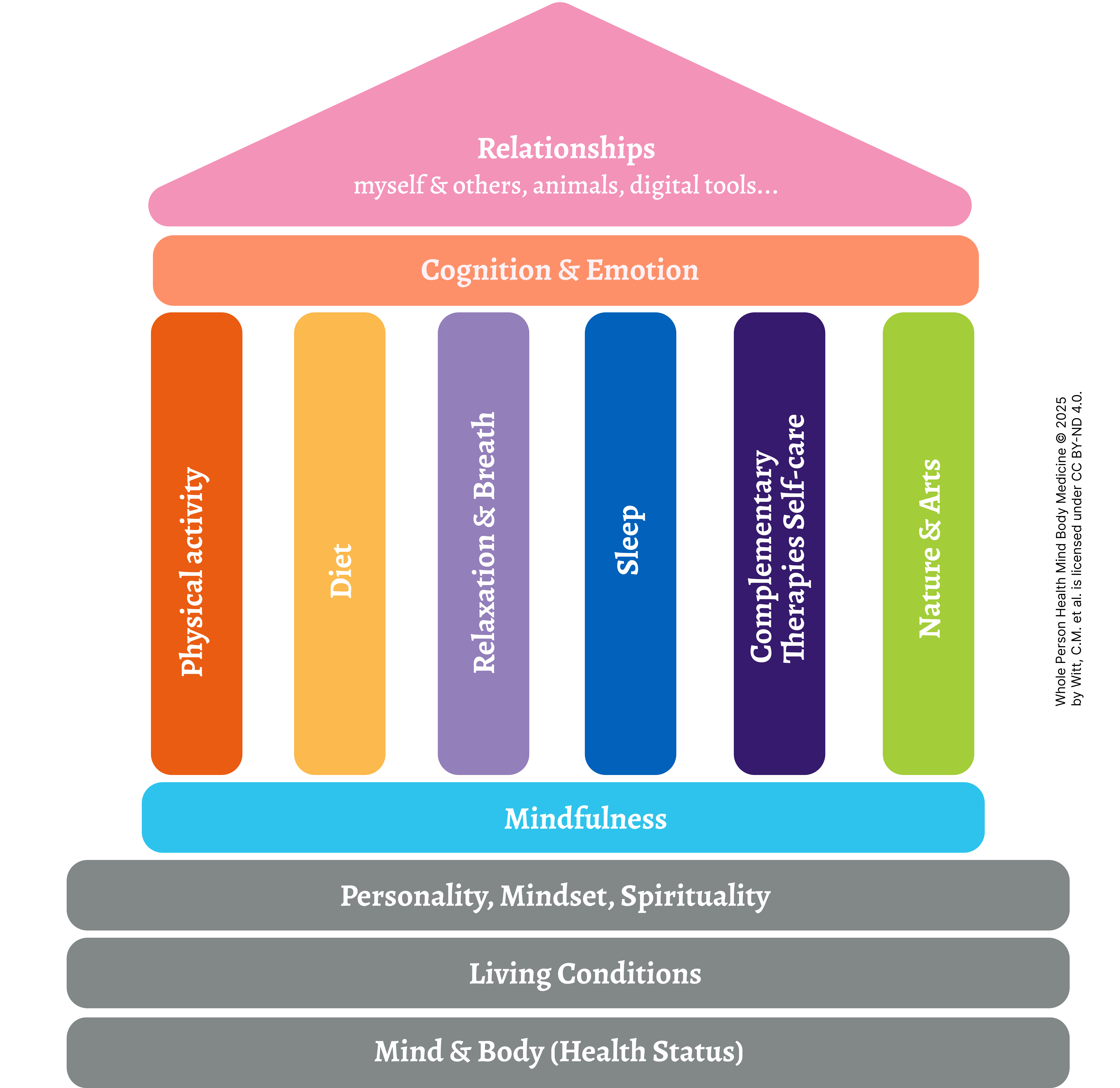
In 2024, we further developed the Temple of Health to represent the Whole Person Health-Mind Body Medicine concept. This visualization supports Mind-Body Medicine consultations and illustrates how various factors and levels are interconnected for a healthy life.
- The foundation represents the fundamental aspects for evaluations and recommendations in Mind Body Medicine. It outlines the context for an individual or a community and includes physical and mental health status, details about life circumstances, as well as information on personality, mindset, and spirituality.
- Mindfulness (depicted as the base plate) plays a special role, as it can be seen both as a foundation and as something that can be cultivated through specific interventions or in combination with other interventions.
- The six pillars of the temple represent resources that can be strengthened through targeted interventions. These include physical activity, nutrition, relaxation & breathing, sleep, complementary self-care therapies, and nature & the arts.
- The ceiling plate represents cognition (thoughts) and emotion (feelings). These arise from an individual’s perception of reality and form the basis for behavior. Mind Body Medicine approaches particularly support cognitive processes and emotional regulation in this context.
- The roof represents relationships. People live in a complex world and have diverse relationships. Various levels of the temple influence relationships. These multifaceted relationships and interactions, for example with oneself, others, animals, the environment, and digital tools—impact both individual and social life as well as overall health.
Nature as a Resource
There is increasing evidence that contact with nature can have positive effects on health and well-being. The positive effects of nature include the reduction of stress and anxiety, the promotion of positive emotions, and the maintenance of interest and attention. Depression and other mental illnesses occur less frequently. On a physical level, various studies have also shown a positive influence on morbidity, particularly in the prevalence of cardiovascular diseases, diabetes, asthma, headaches, and musculoskeletal disorders. Additionally, there are indications that contact with nature promotes social interactions.
Concepts such as "Greencare" or "forest bathing" have been developed and implemented to integrate nature-based interventions into existing therapeutic approaches. Contact with nature can effectively support the achievement of health goals in the context of the bio-psycho-social model.
In Mind Body Medicine, which is committed to the concept of "Whole Person Health," nature plays an essential role. Therefore, access to nature should be evaluated in the context of individual life circumstances and considered in recommendations. Nature can also be used as a therapeutic resource, while simultaneously strengthening the relationship with nature.
Responsible Health Solutions
Die Gesundheit von Menschen, Tieren und Natur sind eng miteinander verbunden. Die Weltgesundheitsorganisation (WHO) definiert One Health Human, animal, and environmental health are deeply interconnected. The World Health Organization (WHO) defines One Health as "an integrated, unifying approach that aims to sustainably balance and optimize the health of people, animals, and ecosystems." In 2023, the University of Zurich established a One Health Institute. One Health Institute etabliert.
This approach highlights how environmental factors—such as pollution, climate change, and biodiversity loss—impact both human and animal health, creating ripple effects across ecosystems. Human actions such as deforestation for agriculture negatively affect wildlife habitats, and contribute to climate change, which in turn affects human health by increasing the prevalence of extreme weather events and food insecurity.
By recognizing these connections, the One Health approach promotes sustainable health solutions that take all areas—humans, animals, and ecosystems—into account, ensuring that improvements in one area do not come at the expense of another.
Mind Body Medicine is interprofessional
In Switzerland, Mind Body Medicine is practiced by health professionals from a wide range of disciplines and is represented, among others, by the Swiss Professional Association for Mind Body Medicine (SFMBM). At the University of Zurich, we also offer a training which combines scientific foundations with practical application: Certificate of Advanced Studies (CAS) “Health Psychology–Based Lifestyle Change and Mind Body Medicine".
Grid containing content elements
Digital Self Care training for People with Cancer-Related Fatigue - A randomized clinical trial
Mehr zu Digital Self Care training for People with Cancer-Related Fatigue - A randomized clinical trialThis project explores whether digital training in self care techniques can reduce cancer-related fatigue, using approaches grounded in digital health and integrative oncology.
Development of digital self care interventions for Cancer-Related Fatigue and sleep problems
Mehr zu Development of digital self care interventions for Cancer-Related Fatigue and sleep problemsThis implementation research study aims to develop a digital, patient-friendly online training that support symptom self-management.
Digital Self Care Offers for People with Cancer
Mehr zu Digital Self Care Offers for People with CancerThis project aims to develop a free digital health offer that provides evidence-based information and practical self care applications in the field of Integrative Oncology.
In Mind Body Medicine, engaging with nature involves conscious contact (nature connection) through one or more senses with living or non-living, individual or collective elements of nature. Not all nature contact inherently supports health and well-being; within Mind-Body Medicine, mindfulness plays a key role in maximizing the benefits of nature.